How Marco Robinson’s #1 International Bestselling Sales Book Outsold Malcolm Gladwell — and Why It’s a Blueprint for the AI Age
There are books that age quietly.
And then there are books that wait.
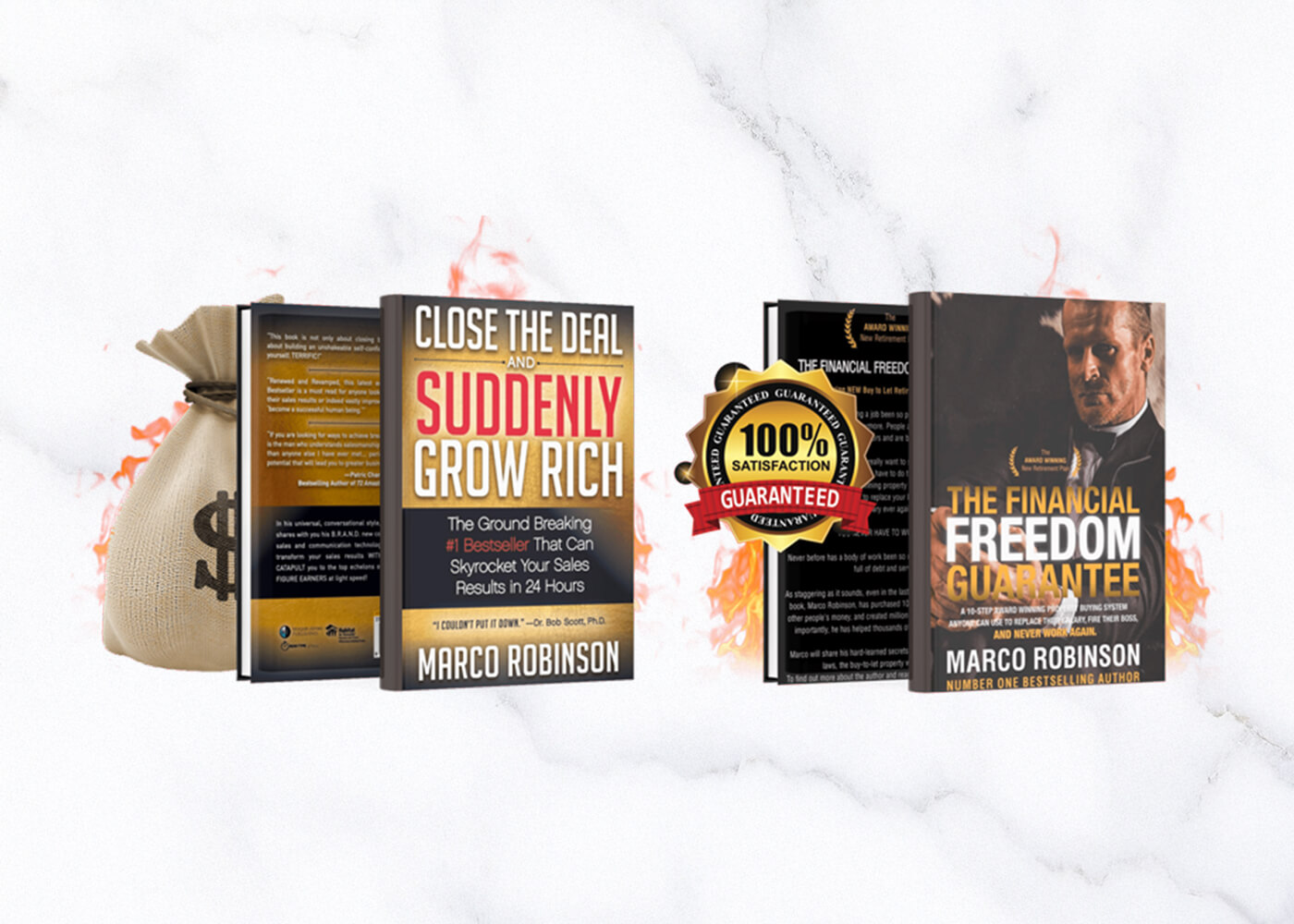
Close the Deal and Suddenly Grow Rich, first published in 2008, belongs firmly in the second category.
For years, it circulated quietly — passed hand to hand, recommended not by trend-chasers but by people who cared about outcomes. Today, as artificial intelligence floods the internet with competence, scripts, and synthetic confidence, the book reads less like a sales manual and more like a warning that arrived early.
And its author, Marco Robinson, sounds like someone who has just remembered exactly who he is.
“I wasn’t trying to build a legacy. I was trying to escape my life.”
Marco Robinson does not tell the origin of the book as a triumph. He tells it as a reckoning.
In 2008, he was already successful. On paper, everything worked. Privately, it didn’t — particularly in his marriage. He describes asking the universe a question successful people are rarely willing to ask out loud:
How do I leave a life that looks right but feels wrong?
The answer, he says, was blunt:
Write a book about your success in sales.
No therapy.
No five-year plan.
Just document what actually works.
Robinson spent six months writing the manuscript and three months editing it himself. There was no ghostwriter. No dilution. Every page came from lived experience — sales floors, boardrooms, hotel lobbies — places where people make decisions when they’re uncomfortable, defensive, or afraid.
“I wasn’t writing theory,” Robinson has said. “I was writing from consequence.”
The book didn’t climb the charts. It flattened them.
When Close the Deal and Suddenly Grow Rich hit the market, it didn’t behave like a typical business title.
It went straight to #1 internationally.
Not gradually.
Not eventually.
For a period, it outsold every major business book in bookstores — including Malcolm Gladwell’s Outliers. A contemporaneous retail ranking screenshot documents that moment clearly. It exists. It will be republished.
This matters not because of Gladwell — whose work remains influential — but because it signalled something far rarer:
A book built on applied human psychology outperforms abstraction at scale.
The market recognized it immediately.
When television stops asking for soundbites
The second signal came fast.
Robinson was invited onto NTV7, TV2, the BBC, and multiple breakfast and current-affairs programmes. These were not promotional appearances. They were long-form interviews — the kind reserved for people whose work is producing visible results.
Television producers are not impressed by ambition.
They respond to momentum.
Salespeople were reporting immediate gains. Business owners were closing deals they had stalled on for months. Teams were changing how they communicated value.
“When television gives you time,” Robinson has said, “it means something has already landed.”
The phone didn’t stop ringing — and the offers escalated
As the interviews aired, Robinson’s phone became unusable.
Corporate invitations arrived daily. Not for motivation — but for implementation.
The first major engagement came from ING Insurance, which booked Robinson to headline its annual conference in front of 10,000 people.
That detail matters.
Corporations do not place untested ideas in front of workforces of that size. They do it when they believe behaviour will change.
One book. One year. Seven figures.
In its first year alone, Close the Deal and Suddenly Grow Rich generated over $1 million.
Robinson has never framed the number as a flex.
The significance, he has said, was leverage.
The book created options.
From bestseller to business — in a collapsing economy
Those options led to MaxGen, a vacation incentive company built on a model that, at the time, looked reckless.
Companies were offered $2,000 holidays in bulk for $50 per unit.
The economics worked because Robinson could access hotel inventory at scale — provided he delivered guests who would engage on-site. It was aggressive, simple, and entirely dependent on trust and timing.
In its first year, MaxGen generated $12 million in sales.
This happened during the subprime financial crisis, when many businesses were cutting costs or folding.
The client list that ended the argument
MaxGen sold to global brands including:
Citibank, IKEA, Shell, BMW, Mercedes-Benz, Nikon, Reader’s Digest, and others.
These organisations do not buy hype.
They buy relevance, authority, and risk reduction.
Those are precisely the pillars Close the Deal and Suddenly Grow Rich is built on.
“This belongs with the classics”
The book’s authority was reinforced by peers who understood the difference between style and substance.
Immanuel Lim, business owner and publisher, was unequivocal:
“He’s really that good. I’d put him right up there with Ziglar, Mandino, Tracy, Girard and Bettger. His books will become classics and mandatory reading for anyone who wants to excel in sales and closing deals — period.”
Paul Counsel, Ph.D., described the book as “safe hands” for anyone serious about results.
Patric Chan highlighted its focus on mindset and identity, not just tactics.
Dr Bob Scott, Ph.D., called it “destined to take its place among the sales classics.”
These were not endorsements written for a launch.
They were classifications.
Why the book now looks prophetic
What has pulled Close the Deal and Suddenly Grow Rich back into focus is not nostalgia.
It is timing.
With AI now producing an estimated 38% more content worldwide — much of it from influencers and personal brands — the market is saturated with competence.
What it is starving for is trust.
“When everyone can generate scripts instantly,” Robinson has observed, “scripts stop selling.”
The book’s central thesis — identity before technique — reads now as foresight. It assumed a world where information would be abundant and credibility scarce.
Authenticity, Robinson argues, is not vulnerability theatre.
It is congruence — when who you are, what you say, and what you’ve done align.
That alignment cannot be automated.
Why the book is being rewritten now
Robinson is updating Close the Deal and Suddenly Grow Rich not to soften it, modernise it, or dilute it.
He is rewriting it to document the evidence.
The updated edition integrates:
- Selling in an AI-saturated market
- Authority when information is infinite
- Storytelling as a trust mechanism, not a tactic
- Personal brand as the final competitive moat
Importantly, the update will be minimal.
Why?
Because the authority of the book has not diluted in the modern age —
it has been strengthened by the advent of AI.
The psychology remains untouched.
The urgency has exploded.
The moment
Most books age quietly.
This one waited.
In a world where anyone can sound smart, the advantage has returned to those who have lived something real, survived it, and know when to ask.
That is why Close the Deal and Suddenly Grow Rich no longer reads like a sales book.
It reads like a manual for the next decade.
And its author sounds like someone who has just remembered exactly who he is.
— Marco Robinson